This is just a quick note to say that the winners of the North Shore Poets’ Forum annual Naomi Cherkofsky contest will be notified this week.
Look here for their names. And, please remember to join the Forum on Saturday, April 17, at the Beverly Public Library, 1 p.m., for the annual reading of the winners’ poems and open mic in honor of National Poetry Month.
William Butler Yeats was born in 1865 and died in 1939, and he is considered one of the leaders of the Irish Renaissance – perhaps the most important. One of my favorite of his poems is The Second Coming. If you’re not familiar with it, just jump onto google and you’re bound to find it. Here are a couple of others, the first very anti-war and the latter full of the woe of the Irish who suffered so much under Cromwell that his memory is a horror.
The Great Day
W. B. Yeats
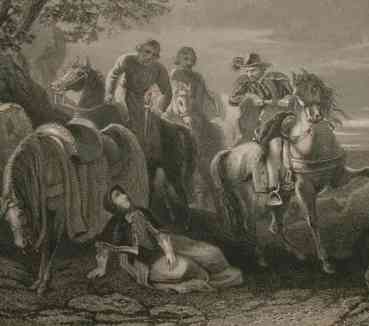
Hurrah for revolution and more cannon-shot!
A beggar upon horseback lashes a beggar on foot.
Hurrah for revolution and cannon come again!
The beggars have changed places, but the lash goes on.
The Curse of Cromwell
You ask what I have found, and far and wide I go:
Nothing but Cromwell’s house and Cromwell’s murderous crew,
The lovers and the dancers are beaten into the clay,
And the tall men and the swordsmen and the horsemen, where are they?
And there is an old beggar wandering in his pride – –
His fathers served their fathers before Christ was crucified.
O what of that, O what of that,
What is there left to say?
All neighbourly content and easy talk are gone,
But there’s no good complaining, for money’s rant is on.
He that’s mounting up must on his neighbour mount,
And we and all the Muses are things of no account.
They have schooling of their own, but I pass their schooling by,
What can they know that we know that know the time to die?
O what of that, O what of that,
What is there left to say?
But there’s another knowledge that my heart destroys,
As the fox in the old fable destroyed the Spartan boy’s
Because it proves that things both can and cannot be;
That the swordsmen and the ladies can still keep company,
Can pay the poet for a verse and hear the fiddle sound,
That I am still their servant though all are underground.
O what of that, O what of that,
What is there left to say?
I came on a great house in the middle of the night,
Its open lighted doorway and its windows all alight,
And all my friends were there and made me welcome too;
But I woke in an old ruin that the winds howled through;
And when I pay attention I must out and walk
Among the dogs and horses that understand my talk.
Given my name, which is three parts Irish, one can hardly be surprised that I would have some affection for the old country. So, with St. Patrick’s Day on the horizon, I have decided to post some Irish poetry, old and not so old, for your reading pleasure.
Of course, I’m as American as they come, with a lot of Irish ancestors. And, I married a man with mostly Irish ancestors. Both of us have a bit of English and/or Scottish. Who knows? My mother spoke of some Scottish ancestor who rowed, or in some other way managed to make it to Clonmany in the far northern part of Donegal, across the waters from some island off the northern coast of Scotland. And, my husband has Wilsons in the lineage, and god knows what they are. So, we aren’t 100 percent.
But, many of the Irish aren’t 100 percent either, since as a people they had always been good at assimilating conquerors, from the Celts to the Danes and Vikings of various sorts. The red hair is supposedly from the Vikings, or so I read somewhere. The Normans made themselves at home in the little isle, with names like Fitzgerald — said to come from fine Norman stock, as are many other Irish of proof-positive names. Even, perhaps, the O’Hares.
Many a good Englishman became enamored of the country they called home for centuries, so that one can hardly say they aren’t Irish, a topic explored by poets like John Hewitt and playwrights like Brian Friel today. The age-old pock-marked history of Irish Catholics and Protestants, too, is a bit of a blur when speaking of such great Protestant Irish nationalists like Yeats and Synge, at the forefront of the 20th century Irish Renaissance in letters, were Protestants from way back, but Irish nationalists for sure.
Power and greed did their best to keep people at each other’s throats, using politics and religion to achieve their own simple ends.
An old story, always reinventing itself for present-day telling. Where to look? Please!
In any case, with St. Patrick’s Day a couple of week’s away, I have decided to share some Irish poems. Once before in this blog I had chosen for your reading pleasure a poem by Coman, called “To Coman Returning,” which the editor of “The Book of Irish Verse,” John Montague, said was most probably from the 9th century. (See entry called “My son is home,” from October.)
Here is another, about the Flight of the Earls –just google it for more information. In brief, the heads of the powerful families of Ulster, which was the epicenter of resistance to the English reconquest of Ireland, fled Ireland in 1607 for Europe, hoping to win Spanish help.
Chances are a lot of us are watching the Olympics whenever we can. There are so many great events and stupendous athletes. How about the Women’s Hockey Team, right? (Young people today seem to end all sentences with the word “right.”) There’s a Danvers young woman on that one, which I care about because I’m the editor of the Danvers Herald. I have to care.
But, really, they withstand such physical tests and such emotional tests. God. I’d rather not go through the pounding heart, sweat, tears, thank you, even if I had the talent.
Now that I think about it, when I was a child, during some very cold, wintry winters, when all of us in the younger set in my neighborhood seemed to go down to the local lake for ice skating, some of us with shovels (or did they just magically appear out of the snow-encrusted pine trees, which may have been dressed-up Ents harboring goodwill toward children?) so that we could skate every day. And, back then, while practicing figure 8 s and speeding along the straight-away portions, I used to dream that I would be in the Olympics someday.
Of course, I was comparing myself to one of my big sisters — actually, both of them — who were pitiful on the ice, one of the few places where I was the star to their distant moons.
And, I’ve also been thinking about the teachers in my children’s school, and some of the do-gooder parents, who used to talk about “dream killers” — that all children should keep hold of that feeling they can do whatever they want to do in the future.
Which brought to mind a poem by Shel Silverstein. Well, I’m elaborating and extrapolating a bit from the real thought process, which was — what poem might go with thoughts about the Olympics? Silverstein supplies more my style of Olympic thinking — that is, gone!
The Little Blue Engine
by Shel Silverstein
The little blue engine looked up at the hill.
His light was weak, his whistle was shrill.
He was tired and small, and the hill was tall,
And his face blushed red as he softly said,
“I think I can, I think I can, I think I can.”
….
So he started up with a chug and a strain,
And he puffed and pulled with might and main.
And slowly he climbed, a foot at a time,
And his engine coughed as he whispered soft,
“I think I can, I think I can, I think I can.”
….
With a squeak and a creak and a toot and a sigh,
With an extra hope and an extra try,
He would not stop — now he neared the top —
And strong and proud he cried out loud,
“I think I can, I think I can, I think I can!”
….
He was almost there, when — CRASH! SMASH! BASH!
He slid down and mashed into engine hash
On the rocks below… which goes to show
If the track is tough and the hill is rough,
THINKING you can just ain’t enough!
For poets in the Beverly area, please join the North Shore Poets’ Forum at the Beverly Public Library on Saturday at 11 a.m. to share poems and gentle critique.
The North Shore Poets’ Forum sponsors an annual, national contest in memory of the late Naomi Cherkofsky, a longtime member. She was a big-hearted woman with a great sense of humor and a lust for life. Those of us who knew her still miss her.
The contest attracts entries from across the U.S., although the majority come from Massachusetts. This is a fine thing, since our state has so many fine poets.
Every year the judging is a challenge, since there are many very good poems but only three money prizes, including $50 for first, $30 for second and $20 for third.
The poems must be no more than 40 lines, but they can be in any form and on any subject. The entry fee is $3 each, with a maximum of five poems per poet. The poets must be 18 or more years of age. Deadline is March 1. Contest chair is Jeanette Maes. Her address is here, under the Contest header above.
Include name, address and contact information (preferably an e-mail address) on one copy; leave the other copy without identification, for the judge. Winners will be notified by e-mail or, if they included a self-addressed, stamped envelope, by mail.
The winners will also be posted on the Web site, and they will be invited to read at the Forum’s annual reading in celebration of National Poetry Day, which is held on the Saturday closest to that day, this year on April 17, at the Beverly Public Library, Gordon Room, 11 a.m. to 1 p.m.
If you have any questions, you can e-mail me here. (I hope the link worked!) (It didn’t work! what did I do wrong? So, comment here, or e-mail me, ckohare2@yahoo.com)
And now for a little poetic inspiration, about shoveling snow, which many of us have done a lot of lately.
Shoveling Snow With Buddha, by Billy Collins
In the usual iconography of the temple or the local Wok
you would never see him doing such a thing,
tossing the dry snow over a mountain of his bare, round shoulder,
his hair tied in a knot, a model of concentration.
……
Sitting is more his speed, if that is the word
for what he does, or does not do.
……
Even the season is wrong for him.
In all his manifestations, is it not warm or slightly humid?
Is this not implied by his serene expression,
that smile so wide it wraps itself around the waist of the universe?
……
But here we are, working our way down the driveway,
one shovelful at a time.
We toss the light powder into the clear air.
We feel the cold mist on our faces.
And with every heave we disappear
and become lost to each other
in these sudden clouds of our own making,
these fountain-bursts of snow.
……
This is so much better than a sermon in church,
I say out loud, but Buddha keeps on shoveling.
This is the true religion, the religion of snow,
and sunlight and winter geese barking in the sky,
I say, but he is too busy to hear me.
……
He has thrown himself into shoveling snow
as if it were the purpose of existence,
as if the sign of a perfect life were a clear driveway
I’m not sure how many people will join us for the meeting tomorrow, Jan. 16. Some had expressed interest, despite the unpredictability of the weather. But, I suppose I was remiss in making the arrangements and contacting everyone in a timely manner. The buck stops here. If I am alone, it is my fault.
But, then again, I have had so little time to be alone since the holidays struck, bringing with them children, gift buying, gift giving, aunts, uncles, nieces, nephews, girl friends and fellow friends at this event or that. And, still, the pace quickens, as my job requires new templates for the website and, given that I’m in the news business, people who continue to be interesting, or sad, or tragically circumstanced, or happily favored, etc.
So, if I am alone, peace be with me.
And, peace be with all the poor people in Haiti, and with all the people of the wide, wide word.
Goodnight.
I have put away my Christmas tree pin and candle earrings for another year. Christmas is over. Away with red and green, and on to blue and silver, a different sparkling of colors for the New Year celebration.
I had a wonderful Christmas, with my three children home and, as my father often joked, mimicking a would-be daughter-in-law’s grandfather, “Nice party, no fights!”
In fact, we had lots of laughter and chatter and food and wine and egg nog and a bottle of Proseco to celebrate the return, after a year, of my daughter from her teaching job in Korea.
All of which is entirely too much personal information for a poetry blog, but some of it may wind up in a poem someday. In the meantime, I offer one by Jane Kenyon, who is truly a marvelous poet. It is called “Taking Down the Tree,” which, as you can guess, is about that last act of the season, something I won’t do until after the New Year, but still, in anticipation, here is her tribute to the past, to the dark of winter, and to extravagance.
Anthony Majahad is a member of the Massachusetts State Poetry Society and good friend to all poets. He is also very patient, since he gave me this for the blog a few weeks ago. I do get distracted.
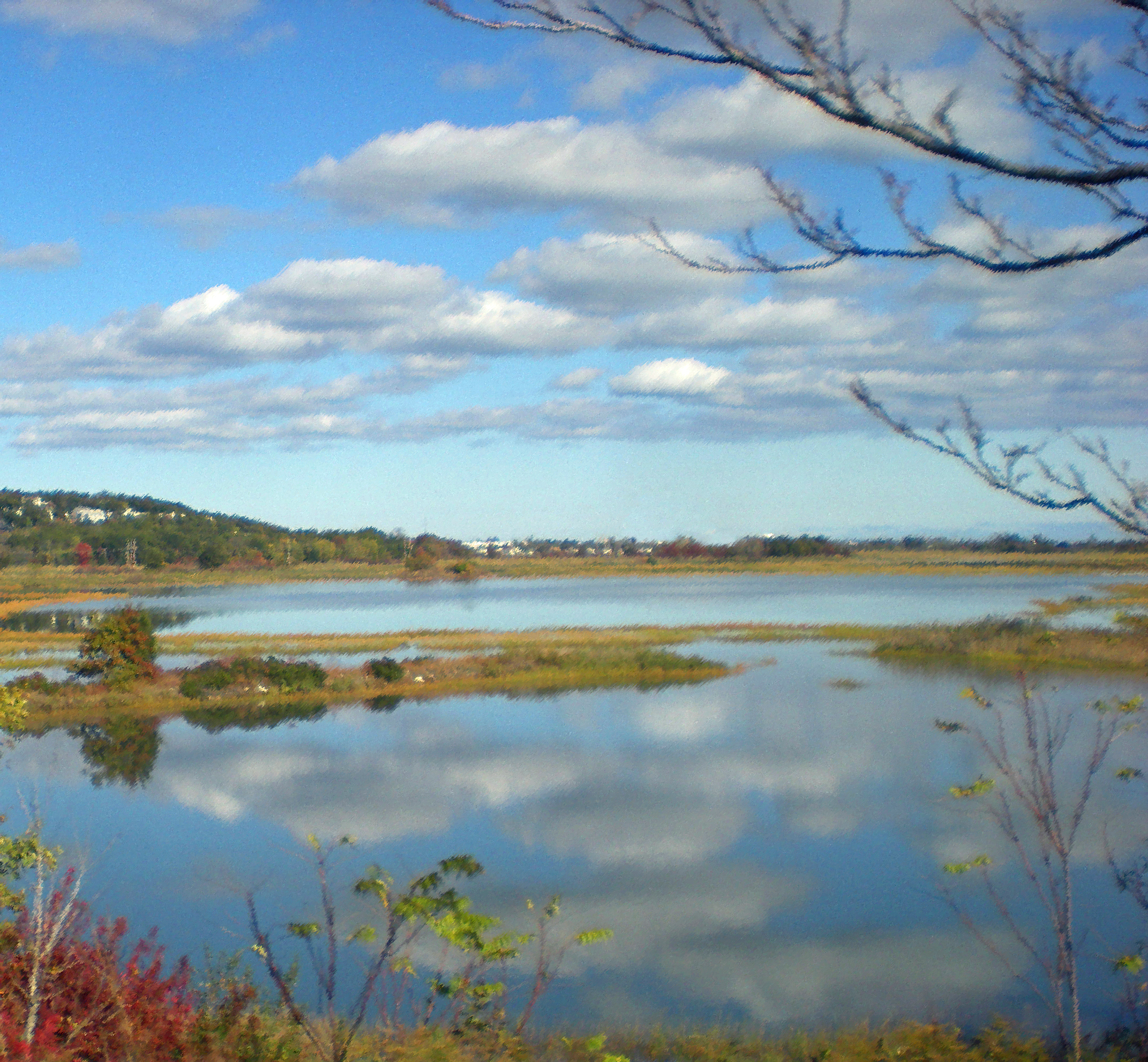
In any case, he happened to be driving by a place familiar to those of us who live on the North Shore and took a photo, which he admits to manipulating in photo shop. Here it is, and his poem.
(Again, please remember that for some reason I can’t get this program to allow stanza breaks, so I distinguish with three dots on a separating line.)
Drive-by―Rumney Marsh
By Anthony M. Majahad
Just before the long steep hill on United States Route 1,
the same US Rt 1 that runs from northern Maine
south to the Florida Keys, where salt marshes
nudged-up against the Revere-Saugus town lines:
…
Glimpse quickly, as you speed by at 55 mph,
and act like a human camera with snapping
shutter, automatic film advance, flash recharge…
…
If you can do this, you might see
an almost Impressionistic landscape
of the once untouched, unadulterated marshlands,
the urban incinerator Photshopped-out of the skyline.
Thanksgiving is, next to Halloween, my favorite holiday. It is so simple. It’s food. It’s love. It’s singing songs — at least in my family — old songs, like Gershwin’s The Man I love or A Foggy Day in Londontown.
And, there’s Tea for Two (by whomever), which the big boys in my family love, because it is so “Mad Men” (have you seen that TV show?) and not at all about the women they married, while the young men can’t even fathom what the heck is so funny about it. (Long sentence there. Oh well.)
It’s Thanksgiving. Some people gather around for whatever big game is on TV. They might go to their own hometown football game in the morning, then go home for the food festivities.
In my family, we begin by singing the silly song, “Thanksgiving Day is Coming, gobble, gobble, gobble, gobble, gobble” (I don’t know the name of the song, but it ‘s utterly silly!).
Thanksgiving is wonderful for all its simple traditions, none of which is written in stone. We don’t have to do anything except serve turkey — and surely, if someone hated turkey, there would be forgiveness for even bypassing this tradition. Some people eat lasagna, salad, and peas.
It’s just about getting together and giving thanks…. for whatever … life, family, sun, rain, the great goddamn beauty of this world, if only we can manage not to destroy it.
And, chances are, as someone said to me , Mother Earth will take care of herself. She’ll get us in the end, if it comes to it and if we’re not careful. So, given all the beauty she has bestowed, thanks for her, too.
Thank you all, for being here, for caring, for sharing. Happy Thanksgiving.
 North Shore Poets' Forum