They have been chosen, and as usual, the choosing among so many good entries was not easy. There were 89 entries in all, and I have begun informing the winners who they are. Those with e-mail addresses will be first, for obvious reasons. I’ll try to call others tomorrow. And, one will have to wait for snail mail, since I don’t have either an e-mail address or telephone number.
In any case, I hope all the winners, and in fact all those who entered and all those who didn’t enter, will join the forum members on Saturday, April 17, for a reading in celebration of National Poetry Month, at the Beverly Public Library. It begins at 11 a.m. and usually lasts about two hours. We have light refreshments available to keep anyone from keeling over. Winners are asked to read first, then the floor is open for other poets to share their work.
Well, drum roll, please, as we announce our winners, and congratulations to all.
——————————————–
First prize: Lee Eric Freedman, “Reflected Figs – four Meditations”
Second: Margaret Eckman, “Oldsquaws”
Third: Brad Pettingell, “only child”
Eight honorable mentions were also awarded, without specific ranking:
Given my name, which is three parts Irish, one can hardly be surprised that I would have some affection for the old country. So, with St. Patrick’s Day on the horizon, I have decided to post some Irish poetry, old and not so old, for your reading pleasure.
Of course, I’m as American as they come, with a lot of Irish ancestors. And, I married a man with mostly Irish ancestors. Both of us have a bit of English and/or Scottish. Who knows? My mother spoke of some Scottish ancestor who rowed, or in some other way managed to make it to Clonmany in the far northern part of Donegal, across the waters from some island off the northern coast of Scotland. And, my husband has Wilsons in the lineage, and god knows what they are. So, we aren’t 100 percent.
But, many of the Irish aren’t 100 percent either, since as a people they had always been good at assimilating conquerors, from the Celts to the Danes and Vikings of various sorts. The red hair is supposedly from the Vikings, or so I read somewhere. The Normans made themselves at home in the little isle, with names like Fitzgerald — said to come from fine Norman stock, as are many other Irish of proof-positive names. Even, perhaps, the O’Hares.
Many a good Englishman became enamored of the country they called home for centuries, so that one can hardly say they aren’t Irish, a topic explored by poets like John Hewitt and playwrights like Brian Friel today. The age-old pock-marked history of Irish Catholics and Protestants, too, is a bit of a blur when speaking of such great Protestant Irish nationalists like Yeats and Synge, at the forefront of the 20th century Irish Renaissance in letters, were Protestants from way back, but Irish nationalists for sure.
Power and greed did their best to keep people at each other’s throats, using politics and religion to achieve their own simple ends.
An old story, always reinventing itself for present-day telling. Where to look? Please!
In any case, with St. Patrick’s Day a couple of week’s away, I have decided to share some Irish poems. Once before in this blog I had chosen for your reading pleasure a poem by Coman, called “To Coman Returning,” which the editor of “The Book of Irish Verse,” John Montague, said was most probably from the 9th century. (See entry called “My son is home,” from October.)
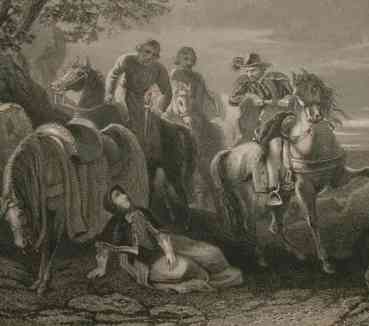
Here is another, about the Flight of the Earls –just google it for more information. In brief, the heads of the powerful families of Ulster, which was the epicenter of resistance to the English reconquest of Ireland, fled Ireland in 1607 for Europe, hoping to win Spanish help.
Chances are a lot of us are watching the Olympics whenever we can. There are so many great events and stupendous athletes. How about the Women’s Hockey Team, right? (Young people today seem to end all sentences with the word “right.”) There’s a Danvers young woman on that one, which I care about because I’m the editor of the Danvers Herald. I have to care.
But, really, they withstand such physical tests and such emotional tests. God. I’d rather not go through the pounding heart, sweat, tears, thank you, even if I had the talent.
Now that I think about it, when I was a child, during some very cold, wintry winters, when all of us in the younger set in my neighborhood seemed to go down to the local lake for ice skating, some of us with shovels (or did they just magically appear out of the snow-encrusted pine trees, which may have been dressed-up Ents harboring goodwill toward children?) so that we could skate every day. And, back then, while practicing figure 8 s and speeding along the straight-away portions, I used to dream that I would be in the Olympics someday.
Of course, I was comparing myself to one of my big sisters — actually, both of them — who were pitiful on the ice, one of the few places where I was the star to their distant moons.
And, I’ve also been thinking about the teachers in my children’s school, and some of the do-gooder parents, who used to talk about “dream killers” — that all children should keep hold of that feeling they can do whatever they want to do in the future.
Which brought to mind a poem by Shel Silverstein. Well, I’m elaborating and extrapolating a bit from the real thought process, which was — what poem might go with thoughts about the Olympics? Silverstein supplies more my style of Olympic thinking — that is, gone!
The Little Blue Engine
by Shel Silverstein
The little blue engine looked up at the hill.
His light was weak, his whistle was shrill.
He was tired and small, and the hill was tall,
And his face blushed red as he softly said,
“I think I can, I think I can, I think I can.”
….
So he started up with a chug and a strain,
And he puffed and pulled with might and main.
And slowly he climbed, a foot at a time,
And his engine coughed as he whispered soft,
“I think I can, I think I can, I think I can.”
….
With a squeak and a creak and a toot and a sigh,
With an extra hope and an extra try,
He would not stop — now he neared the top —
And strong and proud he cried out loud,
“I think I can, I think I can, I think I can!”
….
He was almost there, when — CRASH! SMASH! BASH!
He slid down and mashed into engine hash
On the rocks below… which goes to show
If the track is tough and the hill is rough,
THINKING you can just ain’t enough!
For poets in the Beverly area, please join the North Shore Poets’ Forum at the Beverly Public Library on Saturday at 11 a.m. to share poems and gentle critique.
The North Shore Poets’ Forum sponsors an annual, national contest in memory of the late Naomi Cherkofsky, a longtime member. She was a big-hearted woman with a great sense of humor and a lust for life. Those of us who knew her still miss her.
The contest attracts entries from across the U.S., although the majority come from Massachusetts. This is a fine thing, since our state has so many fine poets.
Every year the judging is a challenge, since there are many very good poems but only three money prizes, including $50 for first, $30 for second and $20 for third.
The poems must be no more than 40 lines, but they can be in any form and on any subject. The entry fee is $3 each, with a maximum of five poems per poet. The poets must be 18 or more years of age. Deadline is March 1. Contest chair is Jeanette Maes. Her address is here, under the Contest header above.
Include name, address and contact information (preferably an e-mail address) on one copy; leave the other copy without identification, for the judge. Winners will be notified by e-mail or, if they included a self-addressed, stamped envelope, by mail.
The winners will also be posted on the Web site, and they will be invited to read at the Forum’s annual reading in celebration of National Poetry Day, which is held on the Saturday closest to that day, this year on April 17, at the Beverly Public Library, Gordon Room, 11 a.m. to 1 p.m.
If you have any questions, you can e-mail me here. (I hope the link worked!) (It didn’t work! what did I do wrong? So, comment here, or e-mail me, ckohare2@yahoo.com)
And now for a little poetic inspiration, about shoveling snow, which many of us have done a lot of lately.
Shoveling Snow With Buddha, by Billy Collins
In the usual iconography of the temple or the local Wok
you would never see him doing such a thing,
tossing the dry snow over a mountain of his bare, round shoulder,
his hair tied in a knot, a model of concentration.
……
Sitting is more his speed, if that is the word
for what he does, or does not do.
……
Even the season is wrong for him.
In all his manifestations, is it not warm or slightly humid?
Is this not implied by his serene expression,
that smile so wide it wraps itself around the waist of the universe?
……
But here we are, working our way down the driveway,
one shovelful at a time.
We toss the light powder into the clear air.
We feel the cold mist on our faces.
And with every heave we disappear
and become lost to each other
in these sudden clouds of our own making,
these fountain-bursts of snow.
……
This is so much better than a sermon in church,
I say out loud, but Buddha keeps on shoveling.
This is the true religion, the religion of snow,
and sunlight and winter geese barking in the sky,
I say, but he is too busy to hear me.
……
He has thrown himself into shoveling snow
as if it were the purpose of existence,
as if the sign of a perfect life were a clear driveway
I have put away my Christmas tree pin and candle earrings for another year. Christmas is over. Away with red and green, and on to blue and silver, a different sparkling of colors for the New Year celebration.
I had a wonderful Christmas, with my three children home and, as my father often joked, mimicking a would-be daughter-in-law’s grandfather, “Nice party, no fights!”
In fact, we had lots of laughter and chatter and food and wine and egg nog and a bottle of Proseco to celebrate the return, after a year, of my daughter from her teaching job in Korea.
All of which is entirely too much personal information for a poetry blog, but some of it may wind up in a poem someday. In the meantime, I offer one by Jane Kenyon, who is truly a marvelous poet. It is called “Taking Down the Tree,” which, as you can guess, is about that last act of the season, something I won’t do until after the New Year, but still, in anticipation, here is her tribute to the past, to the dark of winter, and to extravagance.
Anthony Majahad is a member of the Massachusetts State Poetry Society and good friend to all poets. He is also very patient, since he gave me this for the blog a few weeks ago. I do get distracted.
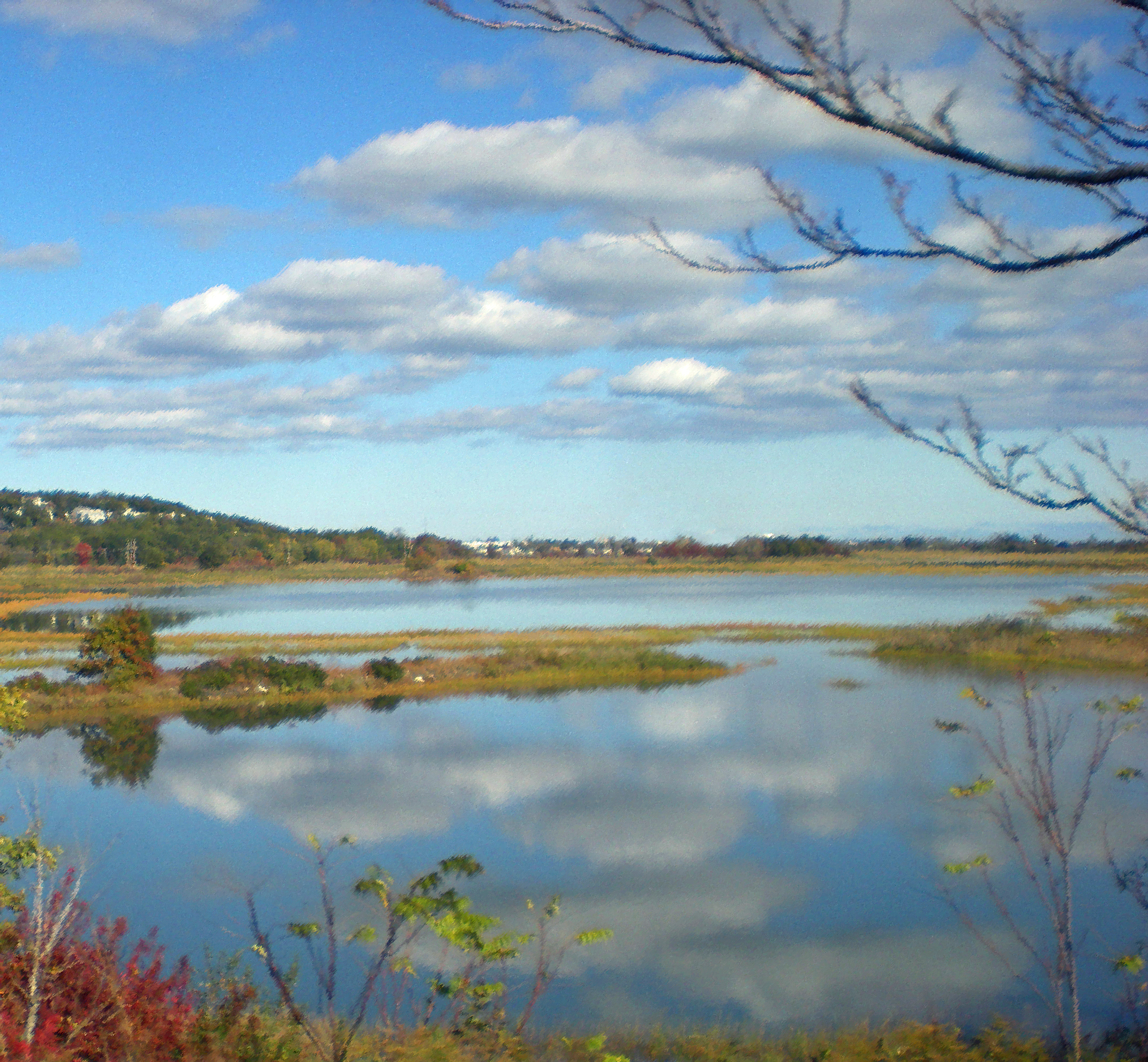
In any case, he happened to be driving by a place familiar to those of us who live on the North Shore and took a photo, which he admits to manipulating in photo shop. Here it is, and his poem.
(Again, please remember that for some reason I can’t get this program to allow stanza breaks, so I distinguish with three dots on a separating line.)
Drive-by―Rumney Marsh
By Anthony M. Majahad
Just before the long steep hill on United States Route 1,
the same US Rt 1 that runs from northern Maine
south to the Florida Keys, where salt marshes
nudged-up against the Revere-Saugus town lines:
…
Glimpse quickly, as you speed by at 55 mph,
and act like a human camera with snapping
shutter, automatic film advance, flash recharge…
…
If you can do this, you might see
an almost Impressionistic landscape
of the once untouched, unadulterated marshlands,
the urban incinerator Photshopped-out of the skyline.
The North Shore Poets’ Forum met on Saturday, and our task was to write a poem, in rhyme, about Halloween. I managed a stanza, but others in our group did wonderfully, especially Roberta Hung, who came up with a villanelle. She won the grand prize, which was nothing more than bragging rights. Still, that’s good.
Anthony Majahad wasn’t able to join us, as he had hoped. But, he sent along a poem to share. It, too, is a villanelle. So, to get you in the spooky spirit, here’s his poem, called “On All Hallows Eve.”
(Again, I’ll indicate stanza breaks with three dots.)
On All Hallows Eve
Souls of the dead return to haunt the living.
Witches ride broomsticks, with their black cats.
October winds mimic souls whimpering.
The full moon shines bright, Hell releases its bats.
…
Evil is in the air, mortals hide and begin shivering,
Warlocks cast spells with cauldrons and bubbling vats,
Cackling witches don their conical hats.
Souls of the dead return to haunt the living.
…
Prayers cannot stop these dead from lingering,
Hell releases demons and black plague rats,
And ghosts fill the night with their bellowing,
While witches ride broomsticks, with their black cats.
…
No one is spared: peasants or aristocrats.
No priest is able to comfort the quivering,
And all hide from the Devil’s diplomats
October winds mimic souls whimpering.
…
Witches and warlocks chant dark spells and sing.
In graveyards, ghouls gnaw dry bones, marrow and fats.
At midnight, the Devil is strengthening,
The full moon shines bright, Hell releases its bats.
…
In the night’s madness, a hastening,
Children afraid of the Devil’s hellcats,
Adults are afraid of almost everything.
At dawn, all is gone; one of night’s only caveats.
Souls of the dead return; church bells begin ringing.
As promised, here is another poem by Melissa Varnavas. I love the watery images, the “s” sounds and alliteration, and so much more.
Melissa joined in the Massachusetts Poetry Festival on Saturday, as one of the MFA readers. I wasn’t able to go, and I haven’t checked with her about how it went. But, here’s hoping it will help get her used to being a featured reader, since she so deserves to be.
Song for the replacement fish my husband bought
Now the red spikey one disappears itself.
In the next vase, the one with its tail tipped
…
too bright for its white body
turns to peer through lamp-lit layers of water dust.
…
Its soft sway,
stirs the murk. But they
…
make me
their captor,
these shadows that swim
magnified
…
by glass, water. In their artificial ponds they go
around
and vanish
so not so much as a cerulean fin shows.
***
His favorite color is blue. He thinks it’s my favorite color, too.
So, that’s why he bought me that one. It’s why he painted the hallway
…
that deep hue, so dark
I had to dabble over it with sky.
***
The first batch died. Turned over in their vases belly-up,
making the water yellow, their bodies
…
bleeding their brilliant color out.
…
I didn’t really want them, these replacement fish.
I happened to be to one who asked Melissa J. Varnavas to join me one day for a North Shore Poets’ Forum meeting, and she’s been off and running with poetry ever since.
She joined the Forum and the Massachusetts State Poetry Society. She joined the Tin Box Poets and the Ipswich Poetry Group. She is now a student at Solstice MFA at Pine Manor Collegecreative writing program in poetry, graduating in January 2010. And, her poetry has appeared in the literary journals Margie and Oberon.
We first met at the Beverly Citizen newspaper, where I was the City Hall/Cop reporter and she came on staff as the Education reporter. She tackled all the challenges of being new kid on the block, and she ended up as the editor of the paper, which pleased her immensely, since Beverly is her hometown.
Life being what it is, and sometimes not so nice, she left that job. But, not before winning a number of awards from the New England Press Association and the Massachusetts Press Association
Now, when she has time from her very busy work and school schedule, she writes freelance articles that have appeared in the Lawrence Eagle Tribune, Danvers Heraldand Boston Now.
She is also the associate director of ACDIS, a professional organization for hospital administrators. And, she’s still winning awards, now with the Specialized Information Publishers Association.
She has agreed to share a few of her terrific poems with us. Here’s the first one. I’m going to ration these, so you’ll have something to look forward to for the next few days. Then, I’ll put up her Introducing … page so that you can refer back to these terrific poems. Maybe she’ll even add more as the months go by.
(Note: to show stanza breaks I am inserting a line with a few dots, because this program does not like to insert the spaces, for some reason. Also, it flushes left.)
A Blessing: Prayer for My Love
The wind in the trees carries
the cicadas hum, their mating call.
…
He says it’s about love. It’s always
about love with him.
…
He loves me so much it makes him
crazy. He smooths my hair
…
with one, big hand and kisses
my mouth hard. I think of this longing
…
as twilight fields soaked in a purple tinge. His eyes
fill with the dimming light that whispers so soft across the pond.
…
I imagine my passion as a steaming cup
of coffee drunk up in sunshine, memories of chocolate.
 North Shore Poets' Forum