The poetry reading and celebration of National Poetry Month is today, at the Beverly Public Library, 11 a.m. Come to the Barnett Room, which is down the hall from where we usually meet.
Tag Archives: North Shore poets
Naomi Cherkofsky contest winners
They have been chosen, and as usual, the choosing among so many good entries was not easy. There were 89 entries in all, and I have begun informing the winners who they are. Those with e-mail addresses will be first, for obvious reasons. I’ll try to call others tomorrow. And, one will have to wait for snail mail, since I don’t have either an e-mail address or telephone number.
In any case, I hope all the winners, and in fact all those who entered and all those who didn’t enter, will join the forum members on Saturday, April 17, for a reading in celebration of National Poetry Month, at the Beverly Public Library. It begins at 11 a.m. and usually lasts about two hours. We have light refreshments available to keep anyone from keeling over. Winners are asked to read first, then the floor is open for other poets to share their work.
Well, drum roll, please, as we announce our winners, and congratulations to all.
——————————————–
First prize: Lee Eric Freedman, “Reflected Figs – four Meditations”
Second: Margaret Eckman, “Oldsquaws”
Third: Brad Pettingell, “only child”
Eight honorable mentions were also awarded, without specific ranking:
Claire Keyes, “Landscape with Bats”
Amy Dengler, “Take Only What You Can Carry”
Olivia Clove, untitled (first line, “Glistening, glittering snow”)
Francis Alix, “The Former Planet”
C.H. Coleman, “With a Waggle Comes a Gaggle”
Ann Staffeld, “Family Fun”
Jill Jackson, “Crow Church”
Melanie J. Lanzo, “Autumn is My Muse”
come to the meeting
The North Shore Poets’ Forum will meet this Saturday, 11 a.m. to 1 p.m. (about), at the Beverly Public Library in the Program Room.
I am supposed to do a brief program on rhymed poetry. .. Please help! Bring a rhymed poem by a favorite write to share.
Also, bring a poem or two for gentle critique.
In the meantime, and in the spirit still of St. Patrick’s Day, here’s another poem by an Irish writer.
THE RAM’S HORN
By John Hewitt
I have turned to the landscape because men disappoint me:
the trunk of a tree is proud; when the woodmen fell it,
it still has a contained ionic solemnity:
it is a rounded event without the need to tell it.
….
I have never been compelled to turn away from the dawn
because it carries treason behind its wakened face:
even the horned ram, glowering over the bog hole,
though symbol of evil, will step through the blown grass with grace.
….
Animal, plant or insect, stone or water,
are, every minute, themselves; they behave by law.
I am not required to discover motives for them,
or strip my heart to forgive the rat in the straw.
….
I live my best in the landscape, being at ease there;
the only trouble I find I have brought in my hand.
See, I let it fall with a rustle of stems in the nettles,
and never for a moment suppose that they understand.
And now for some Yeats
William Butler Yeats was born in 1865 and died in 1939, and he is considered one of the leaders of the Irish Renaissance – perhaps the most important. One of my favorite of his poems is The Second Coming. If you’re not familiar with it, just jump onto google and you’re bound to find it. Here are a couple of others, the first very anti-war and the latter full of the woe of the Irish who suffered so much under Cromwell that his memory is a horror.
The Great Day
W. B. Yeats
Hurrah for revolution and more cannon-shot!
A beggar upon horseback lashes a beggar on foot.
Hurrah for revolution and cannon come again!
The beggars have changed places, but the lash goes on.
The Curse of Cromwell
You ask what I have found, and far and wide I go:
Nothing but Cromwell’s house and Cromwell’s murderous crew,
The lovers and the dancers are beaten into the clay,
And the tall men and the swordsmen and the horsemen, where are they?
And there is an old beggar wandering in his pride – –
His fathers served their fathers before Christ was crucified.
O what of that, O what of that,
What is there left to say?
All neighbourly content and easy talk are gone,
But there’s no good complaining, for money’s rant is on.
He that’s mounting up must on his neighbour mount,
And we and all the Muses are things of no account.
They have schooling of their own, but I pass their schooling by,
What can they know that we know that know the time to die?
O what of that, O what of that,
What is there left to say?
But there’s another knowledge that my heart destroys,
As the fox in the old fable destroyed the Spartan boy’s
Because it proves that things both can and cannot be;
That the swordsmen and the ladies can still keep company,
Can pay the poet for a verse and hear the fiddle sound,
That I am still their servant though all are underground.
O what of that, O what of that,
What is there left to say?
I came on a great house in the middle of the night,
Its open lighted doorway and its windows all alight,
And all my friends were there and made me welcome too;
But I woke in an old ruin that the winds howled through;
And when I pay attention I must out and walk
Among the dogs and horses that understand my talk.
O what of that, O what of that,
What is there left to say?
Given my name…
Given my name, which is three parts Irish, one can hardly be surprised that I would have some affection for the old country. So, with St. Patrick’s Day on the horizon, I have decided to post some Irish poetry, old and not so old, for your reading pleasure.
Of course, I’m as American as they come, with a lot of Irish ancestors. And, I married a man with mostly Irish ancestors. Both of us have a bit of English and/or Scottish. Who knows? My mother spoke of some Scottish ancestor who rowed, or in some other way managed to make it to Clonmany in the far northern part of Donegal, across the waters from some island off the northern coast of Scotland. And, my husband has Wilsons in the lineage, and god knows what they are. So, we aren’t 100 percent.
But, many of the Irish aren’t 100 percent either, since as a people they had always been good at assimilating conquerors, from the Celts to the Danes and Vikings of various sorts. The red hair is supposedly from the Vikings, or so I read somewhere. The Normans made themselves at home in the little isle, with names like Fitzgerald — said to come from fine Norman stock, as are many other Irish of proof-positive names. Even, perhaps, the O’Hares.
Many a good Englishman became enamored of the country they called home for centuries, so that one can hardly say they aren’t Irish, a topic explored by poets like John Hewitt and playwrights like Brian Friel today. The age-old pock-marked history of Irish Catholics and Protestants, too, is a bit of a blur when speaking of such great Protestant Irish nationalists like Yeats and Synge, at the forefront of the 20th century Irish Renaissance in letters, were Protestants from way back, but Irish nationalists for sure.
Power and greed did their best to keep people at each other’s throats, using politics and religion to achieve their own simple ends.
An old story, always reinventing itself for present-day telling. Where to look? Please!
In any case, with St. Patrick’s Day a couple of week’s away, I have decided to share some Irish poems. Once before in this blog I had chosen for your reading pleasure a poem by Coman, called “To Coman Returning,” which the editor of “The Book of Irish Verse,” John Montague, said was most probably from the 9th century. (See entry called “My son is home,” from October.)
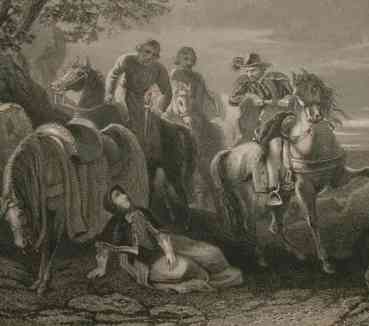
Here is another, about the Flight of the Earls –just google it for more information. In brief, the heads of the powerful families of Ulster, which was the epicenter of resistance to the English reconquest of Ireland, fled Ireland in 1607 for Europe, hoping to win Spanish help.
This night sees Ireland desolate
By Aindrais MacMarcuis
Version: Robin Flower
This night sees Eire desolate,
Her chiefs are cast out of their state;
Her men, her maindens weep to see
Her desolate that should peopled be.
….
How desolate is Connla’s Plain,
Though aliens swarm in her domain;
Her rich bright soil had joy in these
That now are scattered overseas.
….
Man after man, day after day
Her noblest princes pass away
And leave to all the rabble rest
A land dispeopled of her best.
….
O’Donnell goes. In that stern strait
Sore-stricken Ulster mourns her fate,
And all the northern shore makes moan
To hear that Aodh of Annagh’s gone.
….
Men smile at childhood’s play no more,
Music and song, their day is o’er;
At wine, at Mass the kingdom’s heirs
Are seen no more, changed hearts are theirs.
….
They feast no more, they gamble not,
All goodly pastime is forgot,
They barter not, they race no steeds,
They take no joy in stirring deeds.
….
No praise in builded song expressed
They hear, no tales before they rest;
None care for books and none take glee
To hear the long-traced pedigree.
….
The packs are silent, there’s no sound
Of the old strain on Bregian ground.
A foreign flood holds all the shore,
And the great wolf-dog barks no more.
….
Woe to the Gael in this sore plight!
Henceforth they shall not know delight,
No tidings now their woe relieves,
Too close the gnawing sorrow cleaves.
….
These the examples of their woe:
Israel in Egypt long ago,
Troy that the Greek hosts set on flame,
And Babylon that to ruin came.
….
Sundered from hope, what friendly hand
Can save the sea-surrounded land?
The clan of Conn no Moses see
To lead them from captivity.
….
Her chiefs are gone. There’s none to bear
Her cross of lift her from despair;
The grieving lords take ship. With these
Our very souls pass overseas.
The day before a winter meeting
I’m not sure how many people will join us for the meeting tomorrow, Jan. 16. Some had expressed interest, despite the unpredictability of the weather. But, I suppose I was remiss in making the arrangements and contacting everyone in a timely manner. The buck stops here. If I am alone, it is my fault.
But, then again, I have had so little time to be alone since the holidays struck, bringing with them children, gift buying, gift giving, aunts, uncles, nieces, nephews, girl friends and fellow friends at this event or that. And, still, the pace quickens, as my job requires new templates for the website and, given that I’m in the news business, people who continue to be interesting, or sad, or tragically circumstanced, or happily favored, etc.
So, if I am alone, peace be with me.
And, peace be with all the poor people in Haiti, and with all the people of the wide, wide word.
Goodnight.
And, vote for Martha Coakley!
 North Shore Poets' Forum