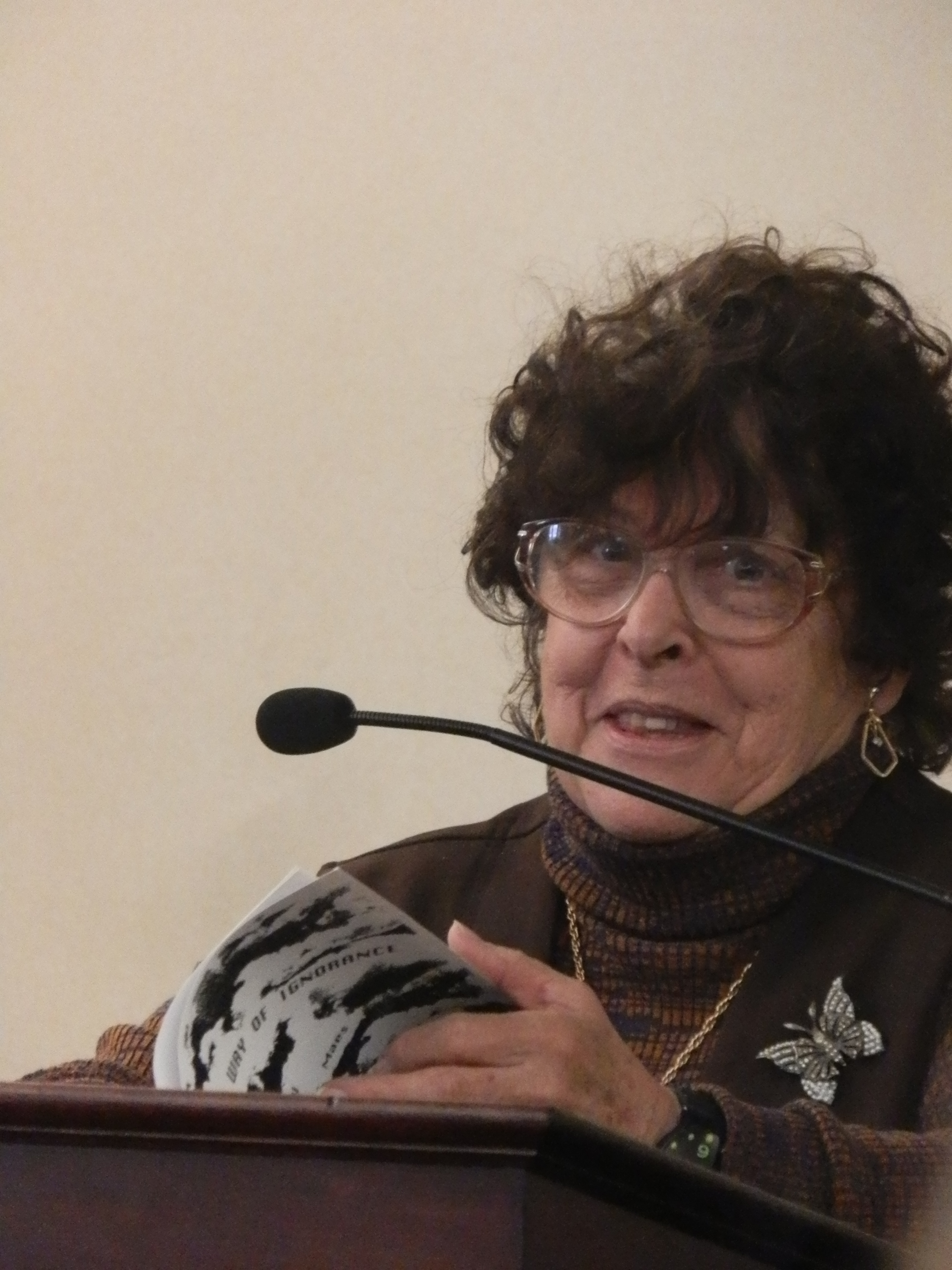
The illustrious leader of the Massachusetts Poetry Society Jeanette Maes.
I’ve been meaning to write a blog post for the NSPF for a while now (everyone knows about the best laid plans and so forth) so here I am the night before the NSPF “big” meeting finally getting down to it.
I love the North Shore Poets’ Forum. I really do. It is one of my go-to poetry groups and every meeting is like reuniting with long lost friends. I first joined the NSPF when I was a cub reporter and only about three years out of college. Cathy O’Hare was the big “City Hall” reporter and mentor to me as I tried to figure out what being a reporter was all about. Since she mentored me on my articles I asked her one day to take a look at a poem I wrote. She praised it and invited me to come to the next meeting.
It was overwhelming but fun. I soon started attending the Massachusetts State Poetry Society meetings and the WordCrafter’s sessions (which took place in Hamilton at the time). After a few meetings, the group invited me to be the secretary. I took my role seriously crafting monthly newsletters and snail mailing meeting updates.
We enjoyed many of the same events that still take place–the regular spring outing and the annual Christmas party. But one of the highlights is the National Poetry Month open mic and Naomi Cherkofsky Contest winners’ reading which takes place tomorrow, Saturday, April 26, 11 a.m., at the Beverly Public Library. It is a chance to throw open the doors of our little group and invite the world to join us in our love of the language and the craft of poetry.
A love of language, a love of books, a love of poetry, and a love of this poetry community = blessed
Typically, we meet the third Saturday of the month and someone offers to do a little presentation on some topic or other. Over the years I have learned about Pulitzer Prize winner writers and delved into the tools of poetry coming to understand things like line break, poetic form, and imagery.
We all bring a speck of food to share and take a break to talk about our lives, about our writing, about our families before we reconvene to share our own poems and partake in a bit of gentle critique. We are a close, connected, and kind community. I love learning and sharing and helping watch my friends grow in their awareness of the wonders of poetry–just as I continue to marvel at the mysteries it unlocks.
Over the years, I have seen how specific poems have been transformed through the hard work of the poet and the loving suggestions of the group. I have grown tremendously from this feedback as well.
We NSPF members are part of a legacy of writers and friends who have been meeting since the 1960s, and sadly, many of whom have passed on. Tomorrow, we will join to congratulate the winners of the Naomi Cherkofsky Contest, named in honor of one such founding poet. Tomorrow, we will memorialize her and we will celebrate the triumph of the NSPF’s continued journey. Tomorrow, we will welcome new friends, honor those contest winners, and toast the poetry of others in our community. And yes, we will share a bite to eat.
So, these are a few of the reasons I love NSPF. I hope you can come tomorrow. I am sure you’ll love it too!
Roberta Hung listens to the winners of the Naomi Cherkofsky Memorial Contest .
There isn’t a harder working intellectual mind full of curiosity and brilliance than Roberta Hung. Unfortunately, Roberta has been busy painting and
Ellie is such a brave and beautiful soul reading from her notebook of thoughts and poems.
participating in an online course regarding ancient Greek history and did not have any new poems to share that wonderfully sunny Saturday we celebrated National Poetry Month by honoring the winners of the Naomi Cherkofsky Memorial Contest and participating in the annual open mic event.
(Roberta, if you happen to read this please post the information about your class and the artistic group in the comments section! )
You can read all about who the winners were in Cathryn’s earlier post. But I was just going through a ton of photos and came across these from our reading.
Richard Samuel Davis received an honorable mention for his poem “Waiting for Deer at the Island Refuge”
(You know how it goes, you take the photos and you love the representation of the
The illustrious leader of the Massachusetts Poetry Society Jeanette Maes.
moment but you never seem to get the pictures developed. It’s as true today in the digital worlds as it was in the days of film. Tell me you don’t have at least a few rolls of film kicking around in a drawer somewhere that you have no idea what’s on it!)
I do so wish that I had been better about posting sooner, so I could give a recount of the wonderful words that were shared. I am sure that I took notes, buried now in my notebook, highlighting some turn of phrase that I loved. I promise that when I do come upon those notes, I’ll leave a comment on this post with them!
At any rate, here are a few of the other photos I took that day (don’t worry Joan, I didn’t take any of you!) and where I think I have the correct identification I’ll make a notation.
Dictionary.com (funny that we used to quote Webster’s or other “books” and now we quote online sources, isn’t it?) defines “reckoning” as:
Noun: 1. count; computation; calculation. 2. the settlement of accounts, as between two companies. 3. a statement of an amount due; bill. 4. an accounting, as for things received or done. 5. an appraisal or judgment.[2]
This morning, my husband Chris and I stayed late in bed remembering his birthday from August. We were on a cruise. I asked the waiter to do something special for him. On the other side of the restaurant, Happy Birthday rang out. He leaned over and whispered, “I hope that doesn’t happen to us.” I agreed, nodding sheepishly, as the crew trotted over singing… not Happy Birthday but doubly embarrassing Happy Anniversary.
I started writing this post earlier this month, maybe even late December, thinking about the nature of turning of the calendar and social/emotional implications of New Year celebrations. The nature of memories. The nature of that reckoning with memories achieved and plans unfulfilled.
The month itself—January—is named for the god Janus, the guardian of the gates of Heaven, ruler of time. When men prayed they were to have prayed to Janus first regardless of the god they hoped to entreat since he was the initiator of human life. He is depicted as two-faced, one facing the front and the other facing the back. To Julius Caesar, who presumably chose Janus and was the first to pick January as the first day of the new year, this symbolized the transition from one year to another. (It is also why Janus is the god of bridges, doors, and gates—because he can see to both sides and all beginnings and ends.)[3]
In the days before my birthday, I worried over the idea of reckoning. What had I learned over the past year? What had I accomplished? (For those of you who don’t know, Cathy O’Hare and I share the same birthday. We are both Capricorns, joined over the span of time–and careers, and hobbies, and love of poetry as well–by the day of our birth.)
Some of you may have read my blog “Reflections on Mackerel Cove.” If you did, then you’d know what a failure it was. I was so excited to begin that project at the turn of 2012. I believed it would re-energize me and my writing.
But blogging lasted most of January, some of February. It came sparsely in March and ended in April. I kept taking photos. Many of which I am proud of. But I never did hand anyone one of my “business” card, never interviewed anyone.
The closest I came was introducing myself to Hannah, a curly-haired blonde who wears big sunglasses and rides her bike to work at Montessori up by Endicott College in Beverly. She reminds me of sunshine even when I think of her now. But otherwise nothing.
I never finished helping my friend Cindy Zelman, a terrific non-fiction writer, with her manuscript. I had trouble keeping up with my email poetry circle and almost never got around to submitting new poems.
I never did floss every day.
I never did take my vitamins every day.
I stopped walking every day, too.
Reckoning.
Although, I can’t say that I never lost a pound. I did. I lost one, then I found one, then I lost five and found five. A year ago, I weighed 165. Today, I weigh 160.
Reckoning.
Yet… I took an exquisite cruise to the Bahamas with the man I love.
I had my first mammogram.
I took my father to his first Red Sox game. Took him on his first ferry ride into Boston, his first Boston taxi-cab ride, his first train ride. He lived 20 minutes away from the city his entire life and never did those things. I will cherish those memories as long as possible.
This year, I bought a new car. My dream car. A 2004 Ford Mustang convertible with 42,000 miles. It leaks water or collects water but I love it. It drives like a dream. I can’t wait until summer.
Reckoning.
Is there more I can do? Of course.
In 2012, I visited my nieces Jessica and Marie. I reconnected with my niece Emily, met her new son.
In 2012, I visited my aunt Ida who wasn’t expected to survive the year. A few days ago, we celebrated her 96th birthday.
I will strive to do more in 2013 but more than that I will strive not to lose faith and not to look for too much more than I already have because I have so much.
Will I make more resolutions to diet and eat better and take my vitamins and floss my teeth and walk more and make good on last year’s promise to take more photos and meet my neighbors and fellow walkers on Lothrop Street? Of course.
I’ve already got my eye on a new juicer.
How do you reckon with reckoning? You don’t. You just keep on enjoying every moment this world, this life, has to give. Forget about reckoning, write and enjoy.
Happy (belated) New Year.
Here are a few New Years’ poems I thought you might enjoy and that I thought were apropos:
Others perhaps get two attempts at New Year’s efforts. They get the option to refresh at the date of their birth, a true new year from their own arrival on the planet and also to revel with the majority in a cultural reboot. This poem by W.S. Merwin recalls the “Janus” face of old.
Writing exercises
Here are a few writing exercises that I thought might be fun for us North Shore Poets’ Forum members to try as we start 2013.
List poem: Think about your resolutions of years’ past. Write out as much of that list as possible (when possible see if you can’t add a date to that list) for me it would be quit smoking, 2001, 2002, 2003, 2004. lose weight, every year/infinity. When you’ve emptied your memory. Take a separate sheet and list out resolutions for 2013. Now review the list with a poetic eye toward composing a “list poem.”
The list poem is just that, a list. It itemizes things, events, and thoughts. It is an easy form of poetry to teach, with one caveat. Yes, a list poem is a list, but the list should be resonant and compelling, driving the reader through the poem.[4]
Changing perspectives: Ask a friend or relative to share their list of New Year’s resolutions with you. Ask them to be honest.
Write a paragraph (keep it private however) about how you feel about your friend and their list. Take a break and get a cup of water or wine.
When you come back write a paragraph about what your life would have to be like for you to have written that same list of resolutions.
Take another break.
When you come back write a paragraph about how you would plan to achieve those resolutions if you were in your friend’s place. When you’re done review your material.
Now write a letter poem (Epistolary poem)[5] either from your own point of view or from your friend offering advice about the new year.
Lyric poem: The perfect day changes your perspective. Creating New Year intentions rather than resolutions frees the mind, enabling you to be creative and flexible. Imagine what your perfect day would look like from beginning to end and be as descriptive as possible. [6]
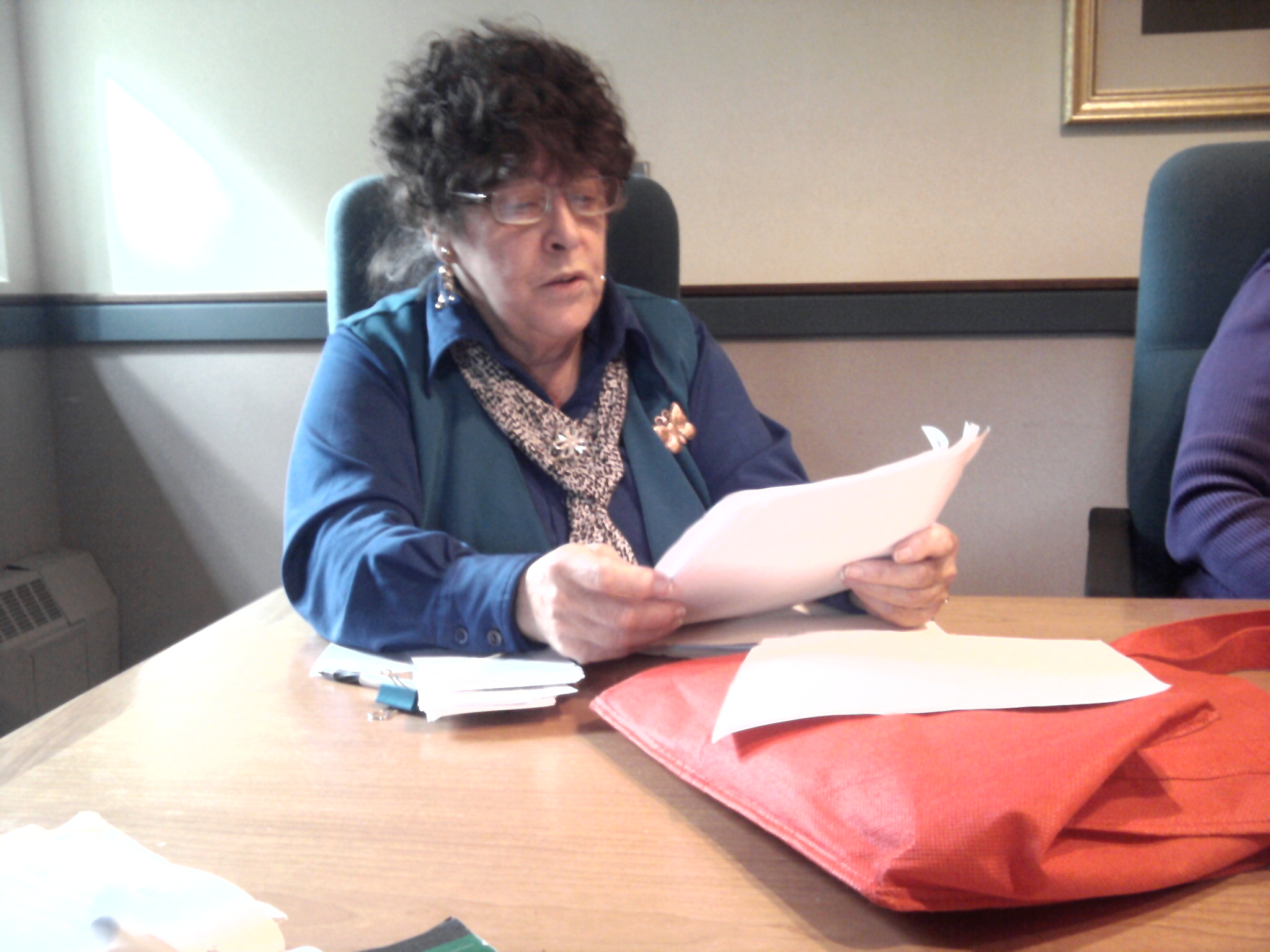
Joan George reads her poem “November at the John George Park” during the North Shore Poets’ Forum November meeting.
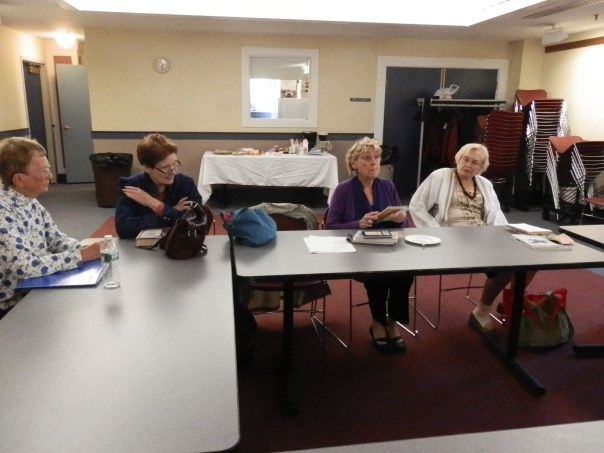
See what I did there? It was line break in a title. Cool right? Well, hardly. But we did enjoy ourselves during the November 17, NSPF meeting. It was held all the way at the top of the Beverly Public Library in the Mezzanine due to the library’s annual book sale. While the book sale (and all the different church holiday fairs going on) made it difficult to find parking, the sale did provide some of us bibliophiles with a little side shopping excursion. I, however, was too nervous about my presentation to the group to do any shopping. I was so nervous I got off the elevator on the wrong floor and had to ask the reference desk librarian how to find the NSPF-ers!
Luckily, the rest of you were not as discombobulated as I was and more than a dozen poets filled the conference room. I certainly wasn’t prepared for such a terrific turnout! I only made 10 copies of my presentation and the poems which went with them. So, as promised here are the links to the materials. You can download the presentation and the supporting materials. I have also included some links to the poems we reviewed today during the session.
For those of you who were unable to make it, you can also review the materials posted here. In my opinion, the important thing to remember is that rhythm, meter, rhyme, dropped lines, enjambment, caesuras, etc. represent tools poets can use to help elevate, to help enhance, the meaning or theme that the poet wants to convey. Every poem has its inspirational point, the genesis of what drew the poet to the blank page. Conveying that inspiration point, often requires quiet contemplation and employment of the tools of our artistic craft. Determining where to break the line is just one of those tools.
I also planned a couple of activities for us to do during the session today but we ran out of time so if you are feeling energized by the meeting and want play around here are those exercises.
Take out the poem you brought to share with us today. On a blank piece of paper write out your poem in paragraph form. Now read it slowly to yourself. Does the change in structure highlight any internal rhythm? Look at the sentence structure and its syntax. Do all your sentences follow the same style and structure or did you alternate the sentence lengths or tones? Now read the poem one more time quietly to yourself and mark with a pencil the places where you naturally pause to breath or natural syntactical segments. Re-write the poem with these new line breaks and awareness. How can you employ line breaks to enhance the point of your poem?
Take a random book down off your shelf. (We were in the library so I was going to have us go and borrow one from their shelves.) It can be a cookbook or a do-it-yourself manual or a collection of essays, anything as long as it isn’t a book of poems! Pull out a paragraph at random and lineate it. How does your lineation affect your understanding? Could you even make a poem from a science book?
After preparing all night for the presentation (okay not “all” night but I was up until 1 a.m.) I took out my Martha Stuart “Living” magazine and flipped through the pages. I came across a Geico advertisement and actually thought about how they had applied line breaks to their message! Pull out your magazines and see if you can find any instances where the point or product of the ad is enhanced by how the words are placed on the page. Ask yourself how it was done and why it worked (or didn’t) on you.
Well that’s all I’ve got folks. I’m sure you’ve all got a ton of information and thoughts about you use line breaks in your own poems. I hope you’ll share them in the comments section below.
See you in December at the joint NSPF/Massachusetts State Poetry Society meeting.
My husband Chris and I love Saturday mornings. To be honest, we love sleeping. So, when my kitten Hugo jumped on my chest at 10:30 a.m., causing me to jolt awake worried I’d missed the scheduled NSPF meeting.
“You’d better get going,” my hubby urged.
“Ugh,” I moaned. But got up, brushed my teeth, combed my hair, grabbed my laptop and bag and headed out the door. I decided to walk since it was snowing and (if you’ve had a chance to look at my blog,) I’m a walker.
I was late and walking would make me later and stopping to grab a coffee would make me later still but I justified my lateness to the snow. I figured you would all forgive me.
I got to the library at about 11:15 a.m., not bad timing, I thought. I looked around but only one person sat in our typical meeting space. I backed up, thinking maybe the meeting was being held in that conference room down the hall. But I knew my mistake. That’s what happens when you get up late and rush around and don’t double check things. I knew the meeting had been canceled.
But there was this gentleman there. So I introduced myself and he, himself. His name is/was Tom and I guess you’ve all met him before as he indicated that he came to a meeting in November. Well, we talked for a while and shared how we each got interested in writing and poetry and I again praised my mentor Cathy for bringing me back into the poetry fold so many years ago.
Then Tom shared of the poems he’d brought which were very good.
We also tried to work on a poetry exercise so I thought I’d share that exercise with you all, too.
Okay, so here goes… You have to play along in order for this work, so no reading through it and skipping ahead. You have spend the time and work through it.
Exercise: Mapping to a sense of place
1. Pick a time in your life. It could be now. It could be during your first job. It could be during your college, high school, or early childhood years. Which ever you pick let your mind go to the memories you’ve stored, the experiences you’ve had about that time.
2. Pick a place you lived during the time you’ve chosen. Visualize this place in your mind’s eye. Now take three minutes (it helps if you have a kitchen timer handy) and describe the physical building where you lived in as much detail as possible. What color was it? How many rooms did it have? Was there a fence? A garden? Did it have a basement or an attic?
3. Take a clean sheet of paper and draw the place you lived in the center of that piece of paper to best of your ability. You have 30 seconds.
4. Time’s up. Now draw the building next door.
5. Now continue this exercise for three minutes until you have a relatively good map of the street/surrounding area of the place where you lived.
6. Now for five minutes go back to your drawing and choose a place on your map that you have not thought about in a long time, imagine that place and the people who lived there in your writing.
Well, this isn’t a formula for a poem per se but a way to get the writing muscles exercised. I did this in a workshop with poet Patricia Smith author of “Blood Dazzler” during the 2011 Massachusetts Poetry Festival. I really enjoyed the workshop and I’m sure I’m not capturing it’s essence well enough here. But what the heck, something to keep us writing on a dreary (now not so snowy) day.
I’m spending some time going through my computer, cell phone, and old cameras doing some New Year cleaning and whatnot and I found some old photos from previous meetings and events. The pictures of Amy Dengler brought a tear to my eye but also a little bit of joy remember what a lovely early summer day it was.
There's nothing better than reading poetry by the ocean with a great group of friends.Mass Poetry Society leader Jeanette Maes gives NSPF members an update at a fall 2011 meeting.Hey, whatca looking at?Who can fit into these shoes? Chris Coleman gives it a shot while Amy and the crew look on.Nice group shot from our summer outing... must have been in 2010?
According to Merriam-Webster, a “habitant” is “a settler or descendant of a settler of French origin working as a farmer in Canada” but we’ve come to understand the word more akin to an inhabitant, or dweller, a residence of a given location over time. Which perhaps begs the question regarding the distinction of “location” and the difference between the nouns “house” and “home” and the emotional connection we feel (or don’t feel) when those words are used.
So this Saturday, May 21, at 11 a.m., at the Beverly Public Library Jeanette C. Maes, president of the Massachusetts State Poetry Society will offer NSPF attendees a workshop titled, “Habitation: House or Home.” After the program, of course, NSPF members can bring their own poems to share for gentle critique. Don’t forget to brin g a goodie or two to share as well.
I’m sure you’ve already heard about all the interesting events taking place on Saturday, May 14, during the Massachusetts Poetry Festival in Salem. There are the poetry trains and trolleys which sound like a ton of fun to me. On the trains, poets have volunteered to help shepherd travelers from Boston’s North Station to Salem by designating a special train car for the Festival. The volunteer then essentially reads poems for the duration of the trip or offers to sort of moderate an impromptu open mic. Then the Salem Trolley pick up passengers and takes them to the various venues again with a volunteer reading poetry as the trolley travels around.
Otherwise I’m pretty torn about what events to attend and how to best schedule my time to get the most out of this very educationally packed day. So, I thought I’d share my preliminary schedule with you and hope that you’ll weigh-in to help me decide. What are you going to? It will be great to be in sessions with other NSPF friends… everything’s better when you’re doing it with friends, isn’t it?
I’ll be volunteering as a “guide” 9-11 a.m. a perfect time as far as that goes because it seems like that will be the key “arrival” period. And it doesn’t seem like I’ll miss too many of the Festival “sessions.”
At 11 a.m. there is “The Art of Critique and the Development of Craft” panel at Colonial Hall. I’m hoping this will provide some insight on different methods to help us NSPF members critique each others’ works when we meet again next time.
At 12:15 p.m., I was thinking about heading over to the Morse Auditorium at the PEM for “Speaking Pictures: Beyond Ekphrastic Workshop” led by Susan Rich. This goes until 1:45 p.m.
I wanted to also make it to the Boston Haiku Society reading 1-2:30 p.m. as preparation for the 2:30 p.m. haiku writing workshop.
At 1:45-2:45 p.m., there’s a workshop called “Becoming the Other: Writing the Dramatic Monologue” which I’d hoped might help provide a little insight on how to enhance “perspective” and “personae” in my poems. But this workshop is all the way over at the House of Seven Gables.
At 2-3:30 p.m. Kim Richey leads a workshop on songwriting that I thought would be a blast to attend with my singer/songwriter/artist/teacher hubby (if, of course, I can rope him into coming with me!).
But… I will be presenting as part of a panel of poets regarding the somewhat controversial topic of why poets should seek to obtain a master of fine arts degree at 3-4 p.m., upstairs in the Old Town Hall. I would really really really love to see some friendly faces in the audience if you don’t already have something scheduled.
Phew! At 4-5 p.m. I’m rushing over to the Salem Anthenaeum for a workshop with Patricia Smith, author of “Blood Dazzler” a collection of poems about Hurricane
Patricia Smith
Katrina that she tells from a variety of perspectives including personifying the city of New Orleans and Hurricane Katrina herself. I just started reading it and it is pretty powerful stuff.
Unfortunately I won’t be able to catch the evening headline readings which feature poets Mark Doty, Kim Richey, and Patricia Smith which starts at 7:30 p.m. at the First Universality Society of Salem. My nephews and nieces need some time with their Aunti.
You’ve probably already received this little “Top 10” list if you are the Massachusetts Poetry Festival e-mail list but I thought it was kinda cute (who doesn’t love poetry jokes?) so I’ll put it in this post:
10. Witch persecutions in Salem no longer an issue.
9. Poetry Trolleys!
8. Watch MC Christopher Lydon try to pronounce “Aimee Nezhukumatathil.”
7. Rare opportunity to hear barbaric yawps.
6. Borders is closing—buy books at the Small Press Fair and book sellers.
5. See secret “eighth gable” in basement of the House of Seven Gables.
4. No problem parking — plenty of meter.
3. Long-form birth certificates not required for entry.
2. Bad poetry—this means you!—celebrated by Steve Almond.
1. Free Versers/Formalists food fight!
Okay then my NSPF friends… help a girl out! What sessions are you going to and where we can meet each other? Maybe next year we can have a NSPF poets reading session in some little Salem café?
The Massachusetts Poetry Festival takes place this weekend.
As many of you already know, the Massachusetts Poetry Festival takes place this weekend, Friday, May 13 and Saturday, May 14 in Salem. I thought I’d take a moment to let you know about a few items and tell you what I’m most excited about/signed up to attend.
During the day Friday, more than 600 high school students will descend on Salem State University to participate in writing workshops from the likes of poets X.J. Kennedy, Sarah Kay, Jericho Brown, and Brian Turner. In the middle of the day the acclaimed documentary Louder than a Bomb will be shown, with an introduction by Adam Gottlieb, one of the featured poets, and Anna West, co-founder of the Chicago slam poetry contest that is the focus of the film. Incidentally if you cannot make it to this screening of the film it will be shown on Saturday also at the Salem Cinema and in June at Boston’s Coolidge Corner Theatre starting Friday, June 3 and at the Salem Cinema starting Friday, June 17.
Workshops for the non-student population begin Friday afternoon. At 4:15 p.m., there’s a presentation on Anne Bradstreet and one on Elizabeth Bishop (some of you may have had the pleasure of listening to Lloyd Schwartz when he came to the Hamilton-Wenham Writer’s Guild back in February or when he presented at the Salem Athenaeum in March). I’m signed up for a program with Richard Hoffman and Robert Gibbons that takes place at The Gathering called “The Rhythm of Resistance and Desire” which promises to help me “find expression that creates a second life in language” by exploring examples of new writing.
At 5:30 p.m., I’ve signed up for a session hosted by Newburyport poet and Powow River Poets founder Rhina P. Espaillat regarding Federico Garcia Lorca (I love him!). During the presentation which takes place at the Peabody Essex Museum, vocalist Ann Tucker will sing five of Lorca’s poems accompanied by guitarist and composer John Tavano. The “melopoeia,” an ancient art form, is a combination of poetry and music. I’ve seen Rhina present a “melopoeia” arrangement before at the Newburyport Arts Association a few years back and it was terrific. I’m sure this event will be great too.
Then, at 7:30 p.m., at the Peabody Essex Museum, there will be readings by four featured poets including:
Brian Turner, author of Here, Bullet, a prize-winning book about the poet’s experience in Iraq, and most recently, Phantom Noise, which was shortlisted for the
Brian Turner, author of the book "Here, Bullet" reads his work Friday night at the Peabody Essex Museum.
2010 T.S. Eliot Prize.
Aimee Nezhukumatathil, author of three poetry collections: Lucky Fish; At the Drive-in Volcano, winner of the Balcones Prize for the best collection of poetry published in 2007; and Miracle Fruit, winner of the Tupelo Press Prize.
Jericho Brown, author of Please, his first book, which won the American Book Award, and recipient of the Whiting Writers Award and fellowships from the National Endowment for the Arts, the Radcliffe Institute at Harvard University, the Bread Loaf Writers’ Conference, and the Krakow Poetry Seminar in Poland.
Enzo Silon Surin is a Haitian-born poet, writer, playwright, advocate and the author of Higher Ground (Finishing Line Press, 2006), which was nominated for the Massachusetts Book Award. Surin’s poem, Blues Prelude (Chicago), is a Pushcart Cart nominee and his poem, Events on Paper Smear, won the Boston Mayor’s 2010 Poetry and Prose Competition.
If you’re not exhausted by the time the featured readings end, head over to the Gulu Gulu Café for the “intercollegiate poetry slam” that takes places from 9:30 to 10:15 p.m. I’m not sure my stamina will take it, especially as I’ll need to be awake to volunteer at 9 a.m. the next morning, but I bet it will be a blast.
There is so much going on I think I’ll end this blog post here and talk more about Saturday’s events in a different post. Are you going to the Festival? What events are you looking forward to most?









 North Shore Poets' Forum